

The dozens of factors that determine a fair election fall into six logical groupings.
Each has a number of criteria to be evaluated and measured. Explore each of the six below.
District Boundaries
Purpose
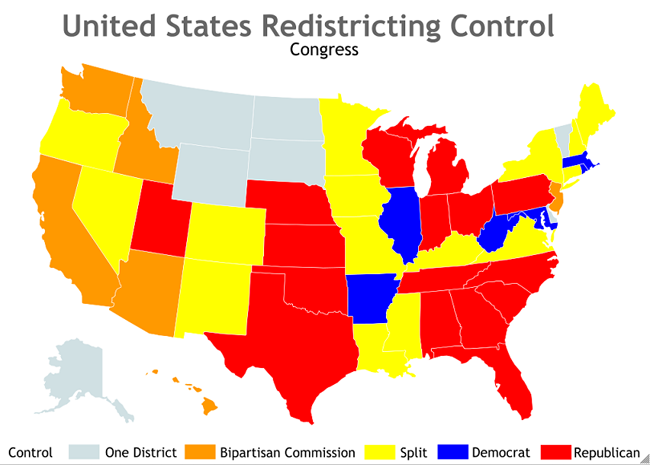
To ensure that individuals are equally represented, that political parties are not given unfair advantages, and that the voting power of members of minority groups are not diluted. “Gerrymandering” is the common term for manipulation in this area.
Possible Components and Measures
Reflective Questions
- Who was in charge of the process?
- Did they intend to draw partisan maps?
- Were other groups frozen out of the process?
- Was one party unreasonably favored?
District Design
- packing
- cracking
Statistical Analysis
- t-test
- lopsided-wins test
- lopsided-margins test
- consistent-advantage test
- efficiency gap test
- reliable-wins test
- excess wins test
Candidate Representation
Purpose
To ensure that candidates from all walks of life can run for office, with equal requirements for doing so, and that public office holders therefore reflect the demographics of the population, to the extent the voters desire.
Possible Components and Measures
- Demographics of candidate slates vs. population
- Review of language in relevant laws
- Evaluation of government and public/private educational and outreach activities that encourage or discourage candidacy.

Voter Registration
Purpose
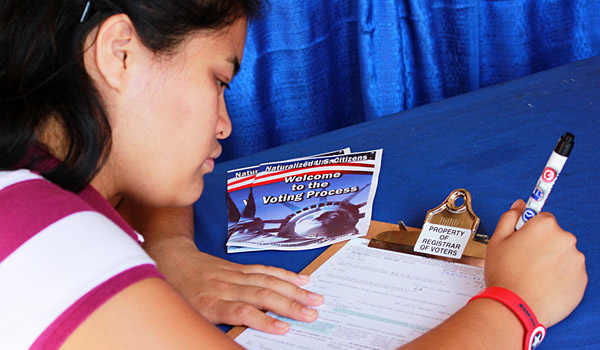
To enable every eligible citizen to vote, through easy, well documented, secure, and unbiased systems, with an eye toward protecting minority rights and thus fulfill the intent of the Constitution.
Possible Components and Measures
Systemic Health
- Multilingual
- Strong nonprofit support system
- Disability friendly/ADA compliant
- Multiple methods available, including in-person, electronic, and mail
- Automatic registration through other transactions (e.g. driver’s licensing)
- Free of charge, and not requiring other transactions with financial obligation
- Simple, non-intimidating identification requirements, sensitive to historical conditions
- Encouragement from government agencies and prioritization by government leader
Analytic Reviews
- % of eligible citizens registered, in total and by demographic type
- Collection and review of reports of citizen experiences
Voting
Purpose
To encourage full participation through a quick, easy, positive voting experience, equally across all geographies and demographics.
Possible Components and Measures
- Early voting access
- Multilingual
- Dependable voting dates and frequency
- Healthy vote-by-mail system
- Voting rights for the formerly incarcerated
- Cost to vote (financial requirements)
- Improper/aggressive voter role purges
- Disinformation to misinform voters
- Ballot design and simplicity of completion
- Length of wait in line, and health safety
- Intimidation at polling sites and drop boxes
- Disability friendly/ADA compliance
- Difficult ID requirements, and/or high rejection
- Plentiful, dependable drop boxes & poll sites
Count & Declare
Purpose
To ensure all votes are counted, quickly and transparently, and results announced as soon as possible.
Possible Components and Measures
- Time between last poll close and announced results
- Disputed votes
- Lost and/or late vote batches
- Proven degree of integrity and professional competence in those managing the system

Digital Security
Purpose
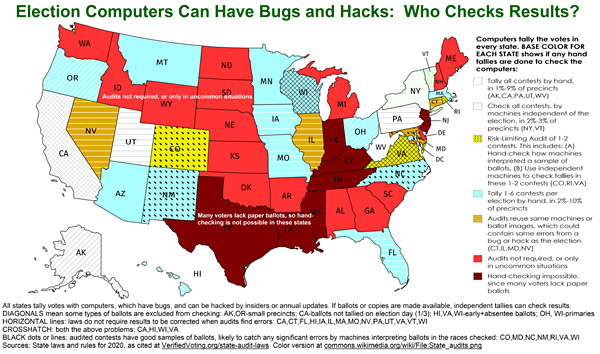
To ensure the entire system is free from electronic hacking and maintains electronic credibility.
Possible Components and Measures
- Cybersecurity standards for registration systems
- Voter-verified paper audit trail
- Post-election audits that test election results
- Ballot accounting and reconciliation
- Return of voted paper absentee ballots
- Voting machine certification requirements Pre-election logic and accuracy testing
- Pre-election logic and accuracy testing
Thanks to The Center for American Progress. Full information can be found in their 2018 report.